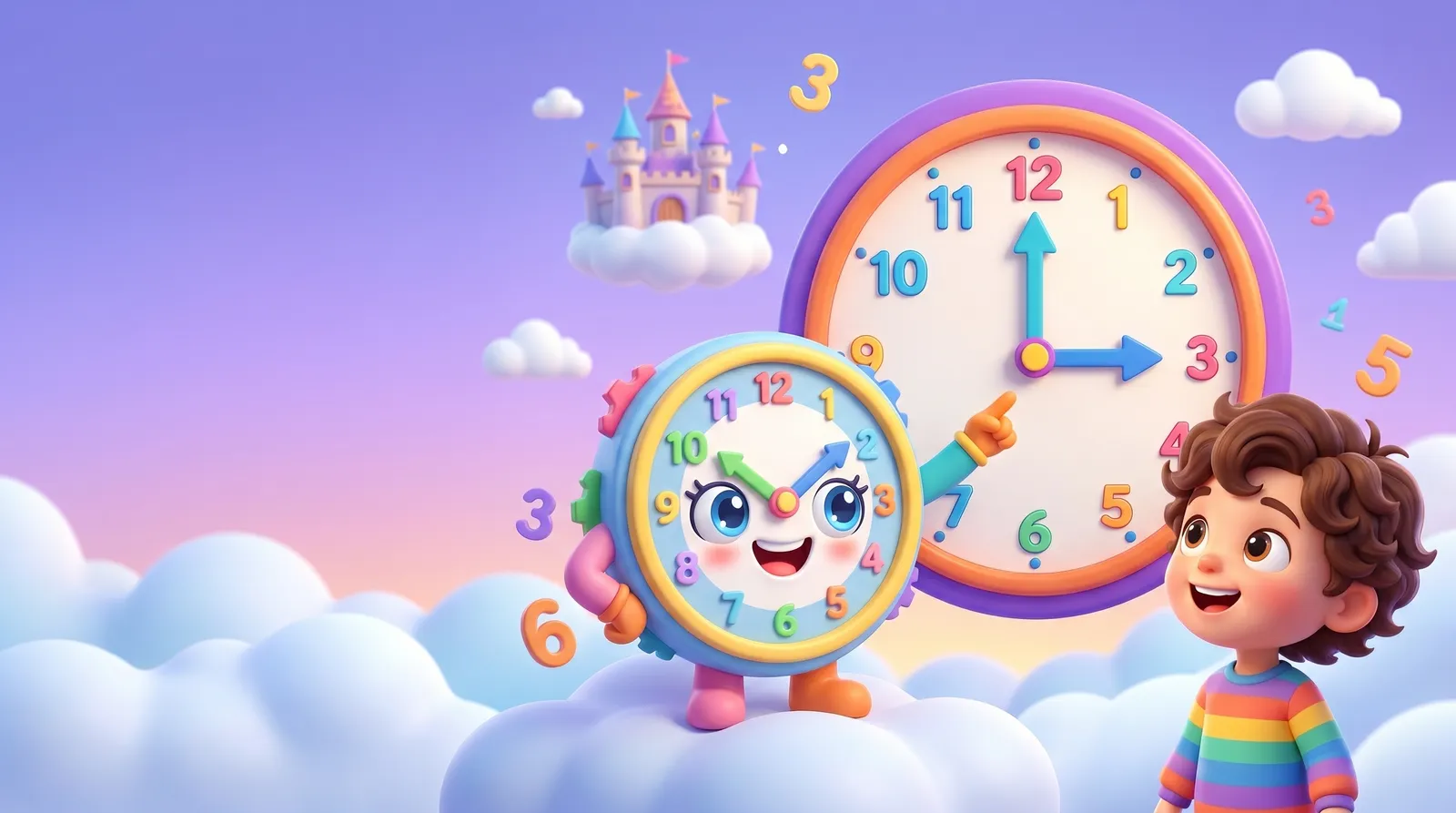
How to Teach Kids to Tell Time: A Step-by-Step Guide
6 min read • Written by the Tick Tock Time team
Teaching a child to read an analog clock is one of the most rewarding milestones in early education. While it can seem daunting at first — after all, a clock face packs a lot of information into a small circle — the right approach makes all the difference. This guide breaks the process into manageable steps that work for children ages 4 to 8.
When Should You Start Teaching Time?
Most children are ready to begin learning about time between ages 4 and 5. At this stage, they can recognize numbers 1 through 12 and understand daily routines ("breakfast time," "bedtime"). Formal clock reading — understanding the hour and minute hands — is typically introduced in kindergarten and 1st grade, with more precise time-telling (to the nearest 5 minutes) following in 2nd grade.
There is no rush. Every child develops at their own pace. The goal is to make the learning process enjoyable, not stressful.
Step 1: Build Time Vocabulary First
Before touching a clock, help your child understand the concept of time through daily conversation:
- Morning, afternoon, evening, night — connect these to activities they know (morning = school, evening = dinner).
- Before and after — "We eat lunch before we play outside."
- Earlier and later — "Bedtime is later than dinner."
This foundational vocabulary gives children a mental framework for understanding what clocks actually measure.
Step 2: Introduce the Clock Face
Show your child a large, clear analog clock (a physical one or an interactive one like Tick Tock Time). Point out the key parts:
- The numbers 1–12 arranged in a circle.
- The short hand (hour hand) — explain that this is the slower hand that tells us the hour.
- The long hand (minute hand) — explain that this moves faster and tells us the minutes.
- The direction — both hands move in the same direction, which we call "clockwise."
A helpful tip: use color coding. In Tick Tock Time, the hour hand is blue and the minute hand is red, making it easier for children to distinguish between them.
Step 3: Master "O'Clock" Times First
Start with the simplest times — when the minute hand points straight up at the 12. At these times, the hour hand points directly at a number, making it easy to read:
"When the long hand points to 12, look at the short hand. Whatever number it points to is the hour. If the short hand points to 3, it is 3 o'clock!"
Practice this with many examples. Ask your child to identify times like 1:00, 5:00, 9:00, and 12:00. Our interactive clock reading quiz starts at this level, making it an excellent practice tool.
Step 4: Introduce Half Hours
Once your child is comfortable with o'clock times, introduce "half past" (or "thirty"). Explain that when the minute hand points straight down at the 6, it means 30 minutes have passed:
- The long hand pointing to 6 means ":30" or "half past."
- The short hand will be between two numbers — it has moved partway to the next hour because time has passed.
This is a great opportunity to explain that the hour hand does not "jump" from one number to the next — it moves slowly and continuously throughout the hour.
Step 5: Teach Skip Counting by 5s
Before introducing quarter hours and 5-minute intervals, make sure your child can skip count by 5s: 5, 10, 15, 20, 25, 30, 35, 40, 45, 50, 55, 60. This skill is essential because each number on the clock face represents 5 minutes:
- The 1 = 5 minutes
- The 2 = 10 minutes
- The 3 = 15 minutes (quarter past)
- The 6 = 30 minutes (half past)
- The 9 = 45 minutes (quarter to the next hour)
- The 12 = 0 minutes (o'clock)
Step 6: Practice with Interactive Tools
The best way to solidify clock-reading skills is through hands-on practice. Interactive tools where children can physically move clock hands build a much deeper understanding than passive observation:
- Setting clock hands: Our online telling time game for kids lets children drag the hour and minute hands to match a target time, with helpful hints along the way.
- Reading clocks: Our free analog clock quiz presents an analog clock and asks children to identify the correct digital time from multiple choices.
- Connecting to daily life: Point out clocks around the house and ask, "What time is it now?" throughout the day.
Tips for Success
- Be patient. Clock reading is a complex skill that involves number recognition, spatial reasoning, and mathematical thinking all at once.
- Keep sessions short. 5–10 minutes of focused practice is more effective than long, tiring sessions.
- Celebrate progress. Every correctly read time is a win worth acknowledging.
- Use both analog and digital. Help your child see the connection between the two formats. When they read an analog clock, show them what the same time looks like on a digital display.
- Make it fun. Games, songs, and everyday conversations about time are far more effective than drills or worksheets alone.
Ready to Practice?
Try our free interactive clock games — no download or account needed!