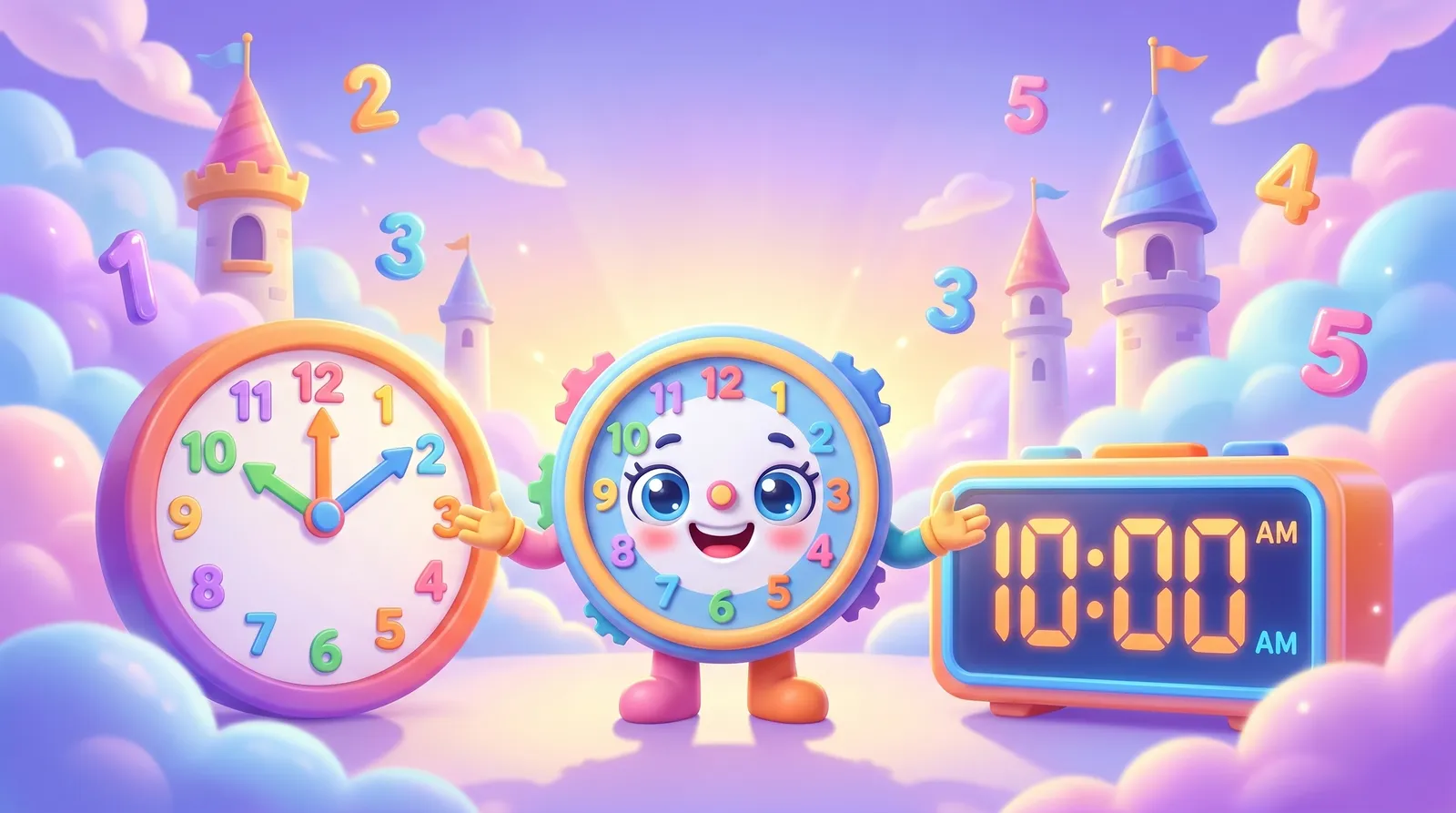
Analog vs. Digital Clocks: Why Kids Should Learn Both
4 min read • Written by the Tick Tock Time team
In a world full of digital screens, many parents wonder: is it still worth teaching children to read analog clocks? The short answer is absolutely yes. While digital clocks provide a quick, convenient way to check the time, analog clocks offer something digital displays simply cannot — a visual representation of how time works.
What Analog Clocks Teach That Digital Clocks Do Not
1. Visual Understanding of Time Passing
An analog clock shows time as movement through space. Children can physically see the minute hand sweep around the dial, which helps them grasp how much time has passed and how much time remains. A digital display like "3:45" is just a number — it does not tell a child whether 3:45 is close to 4:00 or far from it without mental calculation.
2. Foundation for Fractions
An analog clock is essentially a circle divided into sections. When children learn that the minute hand pointing at 3 means "quarter past" or pointing at 6 means "half past," they are building an intuitive understanding of fractions — quarters, halves, and thirds — before they encounter these concepts formally in math class.
3. Skip Counting Practice
Reading minutes on an analog clock reinforces skip counting by 5s (5, 10, 15, 20...). This is a core math skill that extends well beyond clock reading — it helps with multiplication, division, and number sense.
4. Spatial Reasoning
Interpreting the angle and position of clock hands on a circular face develops spatial reasoning skills. Children must process the relationship between two moving objects (the hour and minute hands) in a circular space — a type of thinking that supports geometry, map reading, and problem-solving.
The Role of Digital Clocks
Digital clocks are not the enemy. They are quick, precise, and ubiquitous — on phones, microwaves, computers, and bedside tables. Children absolutely should be able to read digital time. The key insight is that digital time reading is much easier to learn once analog time is understood. The reverse is not true — a child who can only read "3:45" digitally may still struggle to understand what that actually looks like on a clock face.
How to Use Both Formats Together
- Start with analog. Teach children to read the clock face first, beginning with hours and progressing to minutes.
- Show the connection. When your child reads a time on an analog clock, show them the same time displayed digitally. Ask: "See? 3:15 on this clock looks like this on your tablet."
- Practice both formats. Interactive games like our online clock reading quiz present an analog clock and ask children to select the matching digital time — building the bridge between both formats naturally.
- Keep analog clocks visible. Having an analog clock on the wall at home or in the classroom gives children constant, passive exposure to reading time.
The Bottom Line
Teaching children to read analog clocks is not about rejecting technology — it is about giving them a richer, deeper understanding of time itself. The cognitive benefits (fractions, spatial reasoning, number sense) extend far beyond just knowing "what time is it." By learning both analog and digital formats, children develop a complete and flexible understanding of time that serves them throughout school and life.
Practice Reading Analog Clocks
Our interactive clock games bridge analog and digital time reading — completely free!